For the 80th Anniversary of
the Ryazan Regional
Radio Club
The Ryazan Regional Radio Club officially began its existence on August 27, 1946.
The club found a home just a few days later - on August 30, 1946 - following a meeting attended by senior officials of Ryazan and the surrounding region to discuss "the organization of training for radio operators and shortwave radio amateurs". The Ryazan City Housing Administration leased a small semi-basement room to the Ryazan Regional Council of Osoaviakhim *. It was located in the very center of the city, in a handsome corner building that had once housed the well-known Lanin Hotel - at the intersection of Revolyutsii Street (formerly Sobornaya Street) and Lenina Street (formerly Astrakhanskaya Street).
The room was divided into two sections. One was equipped as a radio training classroom with 20 telegraph keys, "fitted with two Morse apparatuses". The other section housed the "radio center" (the club's collective amateur radio station).
The Ryazan branch of Osoaviakhim received Lend-Lease "Marconi-19" transmitters-receivers, AR-88 communications shortwave receivers and KVM receivers from the Moscow region to equip the club's collective radio station.
The station was assigned the callsign UA3KNB. The radio station operated daily, making contacts with radio amateurs and with the main station of the Osoaviakhim Central School in Moscow.
Seven months later, another room was allocated to the Radio Club in the same building, followed by two more rooms in October 1947. Eventually, the total floor area occupied by the Ryazan Radio Club reached 111 square meters.
A major role in establishing the club was played by the well-known Ryazan shortwave operator Vladimir Konstantinovich Palagin, UA3SE (ex U3CL, eu2FD, euRK841), head of the first municipal radio distribution center in Ryazan and one of the city's first radio announcers. The first officially appointed head of the Regional Radio Club, beginning in October 1946, was Alexander Ivanovich Gilyarov, a radio amateur since 1928 and a shortwave operator since 1936.
Many young people were fascinated by radio communication in those years; popular literature and films romanticized polar and maritime radio operators, geologists, and military signalmen. Gilyarov organized classes at the regional club for anyone wishing to learn Morse code. He later arranged regular 15-minute broadcasts of Morse-code practice texts over the city's wired radio network.
Local historian Nikolai Agramakov wrote about the club with affection: "The corner entrance to the Radio Club, beneath two old balconies, inspired a kind of sacred awe in boys who had been initiated into the mystery of those cool rooms, and for many people of Ryazan it determined the course of their lives"
Only one year after the official opening of the Ryazan Radio Club, it already had 87 members and another 60 applicants for membership. Statistical reports noted that during its first year the club had trained "107 radio operators and shortwave operators".
As early as 1947, the team operating the Ryazan Radio Club's collective station UA3KNB took part in an All-Union Radio Test and was recognized in Moscow among the "shortwave operators who achieved the best results".
Among those who made a significant contribution to the development of the Ryazan Regional Radio Club, several names deserve special mention: Nikolai Yakovlevich Chuyev, UA3SI, a renowned designer of amateur radio equipment and one of the active figures in the post-war amateur-radio movement in the Soviet Union; Anatoly Ivanovich Yermolaev, UA3SK, one of the pioneers of long-distance television reception and transmission in the region. And, of course, the Grishin family: Maria Fyodorovna Grishina, UA3SY, formerly a military radio operator and instructor, a veteran of the Great Patriotic War and a republican-category radio-sports judge, and her husband Anatoly Semyonovich Grishin, UA3SS, who headed the club's collective radio station during its early years.
In 1963, the All-Union scientific and technical magazine Radio published an illustrated feature about the Ryazan Grishin family: " Maria Fyodorovna and Anatoly Semyonovich lived in different cities, and both were passionate radio amateurs. They met on the air, during one of their radio contacts". Many veteran Ryazan shortwave operators learned radiotelegraphy from Maria Fyodorovna. They remember with great warmth her kindness and willingness to help with problems at collective radio stations, with learning Morse code, and with obtaining and registering amateur radio callsigns.
During its entire period at 11 Revolyutsii Street, the Radio Club "trained more than four thousand radio operators and shortwave operators". By 1995, the Ryazan Regional Radio Club had 497 members, 272 of whom held amateur shortwave callsigns.
In March 1995, city officials transferred the premises occupied by the Ryazan Radio Club to "other tenants" - a private commercial enterprise. Unfortunately, efforts by local supporters to protect the regional Radio Club were unsuccessful.
And so the Ryazan Regional Radio Club began many years of moving from one location to another around the city. But that, as they say, is another story.
Notes and Sources:
State Archive of the Ryazan Region (GARO).
Nikolai Nikolaevich Agramakov (UA3SED), "Gubernskiy Vek. Historical Collection. Selected Works", Ryazan, 1997.
Andrei Yuryevich Blinushov (R3SE), "Dots and Dashes of the Past Century. A History of Amateur Radio in Ryazan. The Soviet Period", Ryazan, 2018.
The All-Union Scientific and Technical Magazine "Radio", Moscow, 1963.
* Osoaviakhim - the Society for Assistance to Defense, Aviation and Chemical Construction, 1927-1948, the direct predecessor of DOSAAF.
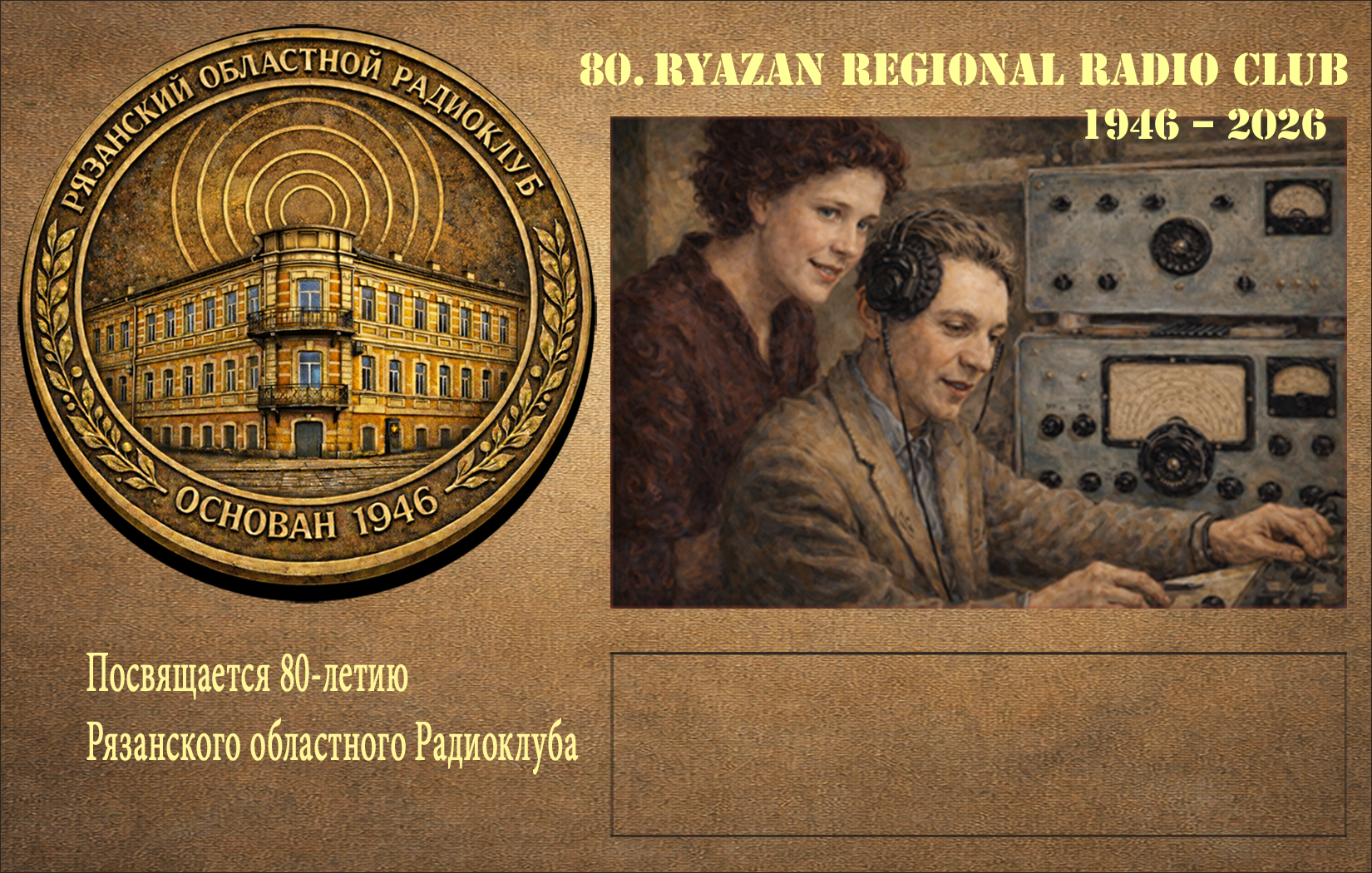
Maria Fyodorovna Grishina, UA3SY, and Anatoly Semyonovich Grishin, UA3SS. Ryazan Regional Radio Club
